
when you’re burned out and don’t know what to do next


Hey sweet friend,
If you read part two and felt seen, but also wondered, “Okay… now what?” this article is for you.
When I was in the thick of burnout, I didn’t need motivation. I didn’t need another routine, planner, or list of things to try. I didn’t even know what the next right step was, and I didn’t have the capacity to research my way out of survival mode.
What I needed was a starting point. Something gentle enough to meet me where I was, but steady enough to help me rebuild.
That is where the 3S Method was born.
This is not a productivity system, a course, or a personality overhaul; it’s a framework I return to anytime life feels heavy, overstimulating, or unsustainable. It is the first step I took after burnout with God instead of trying to power through on my own.
I Didn’t Need Another To-Do List
Burnout is funny.
Everything feels urgent.
Everything feels overwhelming.
Even good things feel heavy.
Yet in all the urgency, I was paralyzed. I couldn’t make decisions but was riddled with anxiety.
I remember wanting to feel better but having no idea where to begin. My brain felt foggy. My body felt exhausted. My spirit felt willing but worn down.
In that place, adding more was never the answer.
What helped was learning how to remove pressure first, then rebuild slowly with intention.
The 3S Method became an easy framework for me to remember how to do that.
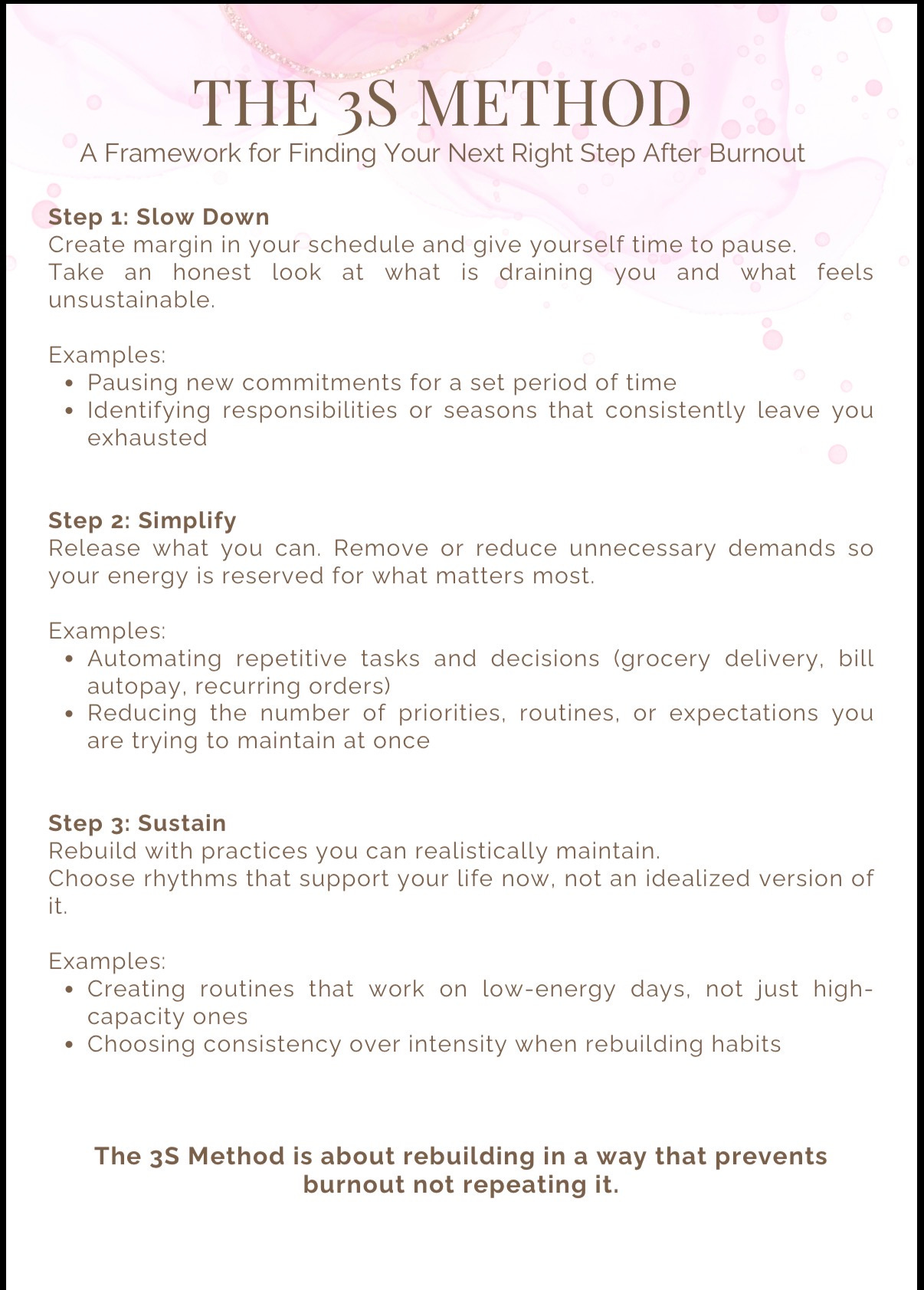
The 3S Method
The 3S Method is made up of three simple steps:
Slow Down
Simplify
Sustain
You do not rush through these. You do not perfect them. You practice them gently, in order, and you return to them whenever life starts to feel heavy again.
Step One: Slow Down
The first step is take a step back and take stock of your life. For me, I was head down in burnout whether from grinding to survive or because it was all just too much to me.
You can’t change direction if you don’t even know which way you’re going.
For years, my life was one long stretch of transition and stress. Even when circumstances improved, my nervous system never caught up. My body stayed in survival mode because it never felt safe to slow down.
Slowing down does not mean quitting everything or doing nothing. It means creating margin so you can actually see what is draining you and what is nourishing you.
For me, slowing down looked like:
Doing the bare minimum on hard days
Letting go of multitasking for the sake of efficiency
Stopping the habit of stacking too many practices at once
Saying no to good things because my capacity was limited
I had to grieve what I could not do anymore before I could rebuild what I could.
Step Two: Simplify
Once you slow down, the next step is release.
Simplifying is about letting go of what you can so your energy can go where it is most needed.
This was one of the hardest steps for me because my pride had to take a back seat. I wanted to be the kind of person who could do it all and keep everything running smoothly.
But burnout forced me to choose stewardship over appearance.
Simplifying for me looked like:
Lowering my standards in certain areas and letting some things stay unfinished
Using easy meals or paper plates during hard seasons
Asking for help and actually accepting it
Outsourcing or delegating what I could and letting go, to the best of my ability, of what I couldn’t
Giving myself permission not to give one hundred percent to everything
When you simplify, you protect the energy you need for the people and practices that matter most.
Step Three: Sustain
Only after slowing down and simplifying can you begin to rebuild.
Sustainability is about choosing what you can realistically maintain in this season, not what looks impressive or ideal.
For me, this meant choosing very small, repeatable rhythms:
A five-minute walk instead of a full workout
A short prayer before bed instead of an elaborate quiet time
A simplified dinner routine instead of constant decision-making
Sustainability asks one simple question:
Can I keep doing this without burning myself out again?
If the answer is no, it is not the right rhythm yet.
Sustainable practices may feel unimpressive at first, but over time they quietly reshape your life.
Where Faith Fits In
One of the most humbling lessons burnout taught me is that I was never meant to carry life with my own strength.
Jesus does not invite us into hustle. He invites us into rest.
“Come to me, all who labor and are heavy laden, and I will give you rest.”
The 3S Method is not about doing less for the sake of ease. It is about learning how to live in a way that honors the limits God gave us.
A soft life is not a lazy life but a surrendered one.
What Comes Next
Now that you have the framework, the next step is learning how to live it out practically.
In the upcoming articles, I will walk through my next framework, The Soft 7 Rhythms for an Intentional Life one by one and show how they layer into the 3S Method in real life.
If you are rebuilding after burnout, start here. Return here often. This is your foundation.
You do not need to overhaul your life overnight. You just need a gentle place to begin.
And always remember, you’re not alone.
Much love,
Sarah
*If you’re finding these frameworks helpful and want a gentle, visual place to return to them, I’ve created a growing digital resource library that brings many of these tools together in one place. It’s designed to be a calm, one-stop companion to the ideas I share here—something you can revisit whenever life feels heavy or overwhelming. This resource is optional, offered with pay-what-you-want pricing, and includes lifetime access as new tools and reflections are added over time.
*If you’ve been encouraged by this post and want to support my writing, you can “buy me a coffee” to help me keep creating gentle, faith-filled content.
I just read this and it felt like a kind hug from a friend. You’re right. I don’t need another to-do list! The fact that it’s easy to remember three S words in a row really helps - I especially liked the point on making it sustainable, because there’s no point in doing something you want to keep up long term if it isn’t realistic for your pace!
Love this Sarah! I have such a heart for overwhelmed and burnt out moms, because I was once one too! And sometimes still am lol. It's only through slowing down and really leaning into Jesus and being led by the Holy Spirit and learning to actually surrender, that moved me out of overwhelm. I still struggle with a disregulated nervous system from years of living with stress and undealt with trauma, but I can recognise and cope with it better because I've learnt from my struggles. I love your method!